
Monday, September 14, 2026 | Today's Newsletter | Login
Taxes Eat Up 42% of Canadian Family Income
By Mata Press Service
Canadian families are handing over a larger share of their income to governments than they spend keeping a roof over their heads, putting food on the table and buying clothes, according to a new analysis of the country's tax burden.
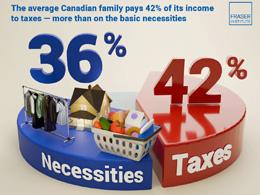
The Fraser Institute's 2026 Canadian Consumer Tax Index estimates that the average Canadian family earned $121,111 in 2025 and paid $50,721 in total taxes.
That works out to 41.9 per cent of cash income.
By comparison, the same family spent an estimated 36 per cent of its income on shelter, food and clothing combined.
The findings offer a stark measure of household finances at a time when Canadians are already grappling with high housing costs, elevated grocery bills and broader affordability pressures.
"At a time when the cost of living is top of mind across the country, taxes remain the largest household expense for Canadian families," said Jake Fuss, the Fraser Institute's director of fiscal studies and co-author of the report.
The study reaches well beyond income tax.
Its calculation includes income and payroll taxes, health levies, sales and property taxes, fuel and vehicle taxes, carbon taxes, import duties, excise taxes and other charges imposed by federal, provincial and local governments.
It also attributes a share of business taxes to households on the basis that those costs are ultimately borne through lower wages, higher prices or returns to investors.
That broad definition produces a tax bill considerably larger than what many Canadians would recognize from their income tax returns alone.
Of the $50,721 estimated total tax bill in 2025, income taxes accounted for $16,085. Payroll and health taxes added another $11,312, sales taxes $6,972 and property taxes $4,307.
The study also assigned $7,182 in business profit taxes to the average family. Fuel, motor vehicle licence and carbon taxes together accounted for $763, while import duties added $510.
The longer-term comparison is even more striking.
The Fraser Institute estimates the average family's total tax bill has risen by 2,928 per cent since 1961.
Over the same period, average spending on shelter increased 2,349 per cent, food costs rose 952 per cent and clothing spending increased 526 per cent.
The Consumer Price Index increased 946 per cent, while average cash income rose 2,322 per cent.
That means the tax bill grew faster than household income, overall consumer prices and every individual category of basic spending measured by the study.
In 1961, the institute calculates that the average Canadian family earned $5,000 and paid $1,675 in taxes, or 33.5 per cent of income.
Families at the time spent 56.5 per cent of income on shelter, food and clothing.
By 2025, those proportions had effectively reversed. Taxes consumed 41.9 per cent of income, while the three basic necessities accounted for 36 per cent.
The shift is visible in the report's historical tables.
In nominal dollars, average spending on shelter rose from $1,130 in 1961 to $27,686 last year. Food spending climbed from $1,259 to $13,249, while clothing increased from $435 to $2,722.
The tax bill went from $1,675 to $50,721.
Inflation explains part of that increase, but the report says it doesn't explain all of it.
Measured in constant 2025 dollars, the average tax bill rose from $17,518 in 1961 to $50,721 in 2025, an inflation-adjusted increase of 189.5 per cent.
The Fraser Institute attributes the increase to a combination of rising incomes and a higher effective tax burden.
Average family income has climbed sharply since 1961, which by itself would have generated a larger dollar tax bill. But the study estimates the average tax rate also rose from 33.5 per cent of cash income in 1961 to 41.9 per cent last year.
The report also warns that today's figures don't capture the full cost of government spending financed through deficits.
The authors argue that deficits represent deferred taxation because government borrowing must eventually be serviced or repaid through future revenues.
If current federal and provincial deficits were counted as taxes in the year the spending occurred, the institute estimates the tax index would show a 3,234 per cent increase since 1961 rather than 2,928 per cent.
The report notes that federal and all 10 provincial governments were expected to run operating deficits in the 2025-26 fiscal year, totalling a combined $107.3 billion.
There are important qualifications to the numbers.
The index doesn't track the same household through six decades. It compares a family earning the average income in each year, and the composition of the average Canadian household has changed significantly since 1961.
The institute notes that today's average family is older, has fewer members and is more likely to own a home and vehicle than its 1961 counterpart.
Some expenditure figures are also estimated. Shelter costs before 1998 were adjusted to account for changes in Statistics Canada's definitions, while 2024 and 2025 household expenditures were estimated from the 2023 Survey of Household Spending and adjusted for inflation.
And because the Fraser Institute uses a wide measure of taxation, including taxes levied directly on businesses, its figure shouldn't be read as the amount an average family literally writes in cheques to government each year.
Still, the report's central comparison is hard to ignore.
For every $100 earned by the average Canadian family last year, almost $42 was attributed to taxes. About $23 went to shelter, $11 to food and just over $2 to clothing.
The remaining income had to cover everything else, including transportation, utilities, child care, health expenses, education, recreation and savings.
Fuss said Canadians can judge for themselves whether they receive adequate value for the taxes they pay.
But he said they should know the scale of the bill and how quickly it has grown relative to the expenses that dominate household budgets.
"While Canadians can decide for themselves whether or not they get good value for their tax dollars, they should understand how much they pay in taxes each year and how much the tax burden has grown relative to other necessary costs they must pay," he said.
For households already watching every dollar, the study adds another dimension to Canada's affordability debate.
Housing and grocery prices may attract the most attention at the checkout counter or when the mortgage payment comes due.
But measured across the full range of taxes collected directly and indirectly, government remains the biggest claim on the average Canadian family's income.
Leave a comment