
Saturday, October 10, 2026 | Today's Newsletter | Login
NDP Targets Ottawa’s New Strikebreaking Tactic
By Isaac Phan Nay
Local Journalism Initiative Reporter
NDP MP Jenny Kwan says she’s looking for a way to stop the federal government’s increasingly frequent intervention to end strikes.
In the last 14 months, the government has invoked Section 107 of the Canada Labour Code to try to end at least eight strikes in federally regulated industries.
The use of Section 107 has been controversial. A group of employers says it can be used to avoid economic catastrophe caused by prolonged labour stoppages.
But unions across Canada have spoken out against the increasing use, saying it violates workers’ Charter rights and increases employers’ power. Teamsters Canada is challenging Ottawa’s use of the legislation in court.
Last month, the government’s quick move to end the Air Canada flight attendants’ strike put the fight over the little-known piece of the labour code in the spotlight.
Now, Kwan says she’s hoping to pressure the government to stop using Section 107 to end strikes.
“What we’re seeing is a Liberal government abusing its power, in my view, in violation of the workers’ right to strike that’s prescribed in our Charter,” Kwan said. “How do you stop this from happening?”
Kwan said she is still researching possible changes to the law.
Section 107 says that to secure “industrial peace” or promote conditions favourable to dispute settlement, the labour minister can refer any question to the Canada Industrial Relations Board and direct the board to take action, including ordering workers to return to the job.
“It’s extremely open-ended,” said Bea Bruske, president of the Canadian Labour Congress. “It gives the government wide-ranging powers to enact pretty much whatever they think would be helpful to try to resolve a labour dispute.”
Her organization, which represents more than three million unionized workers across Canada, has called for Prime Minister Mark Carney to stop using Section 107 to end strikes.
The only tactic workers have to win better pay and treatment is withholding their labour, Bruske said. Taking that power away from workers hinders negotiations, she added.
“It’s just egregious that it’s being used to this extent to stymie actual collective bargaining,” she said.
Section 107 has been part of the Labour Code for more than 40 years. It was mostly unused until 2011, when the then-labour minister Lisa Raitt used it during an Air Canada strike after the union twice voted down collective agreements.
But in June 2024, the government started frequently invoking Section 107 to try to end labour disputes in federally regulated industries, starting with a WestJet engineers’ strike.
The Canadian Labour Congress’s Bruske said she believes the federal government started invoking Section 107 to direct the Canada Industrial Relations Board to intervene in labour disputes because it realized it was a much faster way to bring an end to them.
Before the government started interpreting Section 107 in this way, back-to-work orders had to be debated and voted on in the House of Commons. For example, in 2018, the House passed a Liberal bill that would end a Canada Post strike that year.
“At least workers would be able to see what the debate was and how their MP voted,” Bruske said. “This is really a very quick way to circumvent having a healthy and rigorous debate in our Parliament.”
In August 2024, Derrick Hynes, then-CEO of a federally regulated employers’ association known as FETCO, wrote an open letter calling on then-labour minister Steven MacKinnon to ensure stability amid “some of the most contentious collective bargaining that the federally regulated sector has seen in decades.”
The letter identified Section 107 as a way for the government to intervene amid a strike by workers at Canada’s major railways.
“Section 107 is broadly tailored to address and avoid the very sort of economic catastrophe that will occur within the next week,” Hynes said.
Daniel Safayeni, the new CEO of FETCO, said an increasing number of work stoppages in the federally regulated sector threaten to undermine the stability of Canada’s essential infrastructure, transportation, communications and trade. Federally regulated industries include airlines, railways, banks and telecommunications companies.
“It does so at a time when Canada is searching for their economic sovereignty and actually puts us at a disadvantage globally,” he said. “To address this, the government is going to require stronger tools to help resolve repeated labour disruptions and to ensure every sector of the economy can continue operating effectively.”
Safayeni added that the issue is of “national economic significance.”
“We could have our rails ground to a halt, shipping stalled. We could have flights grounded, as we saw was the case with Air Canada and the enormous headache that caused,” he said. “More broadly speaking, we’re going to have a chill on investment in this country.”
The government subsequently used Section 107 to get the Canada Industrial Relations Board, or CIRB, to intervene and order three groups of Canadian National Railway and Canadian Pacific Kansas City employees back to work.
Teamsters Canada, the union for all three groups of workers, announced it planned to fight the CIRB’s directions in Federal Court.
In July, the union said it had filed six applications for judicial review. Three ask the Federal Court of Canada to consider whether the use of Section 107 to end strikes violates workers’ Charter rights to free association and freedom of assembly. Three more ask courts to reconsider the reasonableness of the CIRB’s decisions.
The cases will test the uses of Section 107 and help define when the legislation can be used.
But Bruske of the Canadian Labour Congress said these cases are expensive and could take years.
“There are many rounds of bargaining that are coming up right away,” she said. “We don’t want to wait to see a very long, protracted legal fight. We need to see an end to this now.”
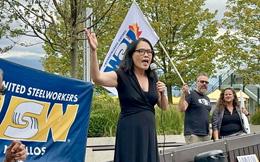
Enter Kwan. At a rally during the Air Canada strike in August, the Vancouver East MP told picketers that when Parliament resumes in the fall, the NDP will bring legislation to ensure flight attendants are paid for unpaid ground work — one of their union’s main sticking points in negotiations.
Former NDP MP Bonita Zarrillo brought a bill to address the issue to Parliament last October, but the bill never made it through the House of Commons.
“We will be retabling this piece of legislation and putting pressure on the government to do what’s right,” Kwan told a crowd at the Vancouver airport.
“And get rid of 107,” a bystander shouted.
“And get rid of 107,” Kwan replied, starting a chant at that rally.
In an interview with The Tyee, Kwan said that while she wasn’t aware of any bills to specifically target Section 107, she was “looking into this matter, and what options are available to address this.”
“Increasingly, what the government is doing is invoking Section 107 as a means to sidestep the need to go to Parliament with back-to-work legislation,” Kwan said. “It’s in violation of the workers’ rights to collectively bargain, and also tipping the scales right heavily towards the employer.”
Kwan said she’s researching how to amend the labour code to uphold workers’ strike rights.
“There are other components that might relate to Section 107 that should be examined carefully so that we don’t end up with negative unintended consequences by striking it,” she said.
Leave a comment