
Saturday, March 07, 2026 | Today's Newsletter | Login
Coastal First Nations say no to oil pipeline
By Sonal Gupta
Local Journalism Initiative Reporter
Following a closed-door meeting with Prime Minister Mark Carney last week, Coastal First Nations leaders said they are still firm in their opposition to a new oil pipeline.
"Our interest isn't about money in this situation, it's about [the] responsibility of looking after our territories and again nurturing the sustainable economies that we currently have here," said Gaagwiis Jason Alsop, President of the Council of the Haida Nation and vice president of CFN, speaking at a press conference.
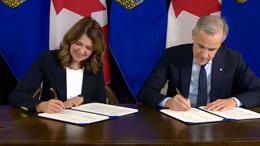
The group of coastal nations has been a primary voice against the proposed pipeline carrying bitumen from Alberta since an MOU was signed between Carney and Alberta Premier Danielle Smith in November. Their opposition goes back more than a decade to a previous proposal, Northern Gateway, which was defeated in part by the nations’ opposition and the proponents’ lack of consultation with them.
First Nations leaders invited the prime minister to meet on their territory to speak with him directly about North Coast resource projects and shipping, including the controversial Alberta oil pipeline that would bring oil tankers to the region.
“Any time there is a discussion about our territories, we need to be in the room,” said Marilyn Slett, president of the Coastal First Nations/Great Bear Initiative and chief councillor for the Heiltsuk Tribal Council. "It is very important to us that the prime minister see our territories and understand our concerns.”
Ahead of the meeting in Prince Rupert, Carney told reporters the discussion with Coastal First Nations leaders was to have a “dialogue” on the “decisive moment” Canada finds itself in. He said he planned to discuss the economic opportunities as well as the importance of conservation in the region, which he acknowledged was core to the identity of Indigenous nations.
“Today is not a day for big announcements, it’s a day for dialogue,” he said. Joining Carney at the meeting were Natural Resources Minister Tim Hodgson and Housing and Infrastructure Minister Gregor Robertson.
At the time of the signing of the Alberta-Ottawa deal, Hodgson said he could host meetings with nations over Zoom — comments he apologized for shortly after. He reiterated his apology to Coastal First Nations leaders on Tuesday.
Speaking to reporters after the meeting, the First Nations leaders said no commitments were made and the discussion focused on identifying shared priorities.
Alsop said the meeting focused on identifying areas of alignment where First Nations and the federal government could work together, particularly as the prime minister confronts broader economic and leadership challenges, while understanding the real-world impacts of proposed projects on the North Coast, including effects on communities, culture and local economies.
"We need to make sure that we are investing in stewardship and the response, planning and the ability to deliver in responding to any emergencies, any accidents,” he said.
In response to questions by Canada’s National Observer about whether economic development and marine conservation were being linked during the meeting, Alsop said Carney did not frame conservation investments as a trade-off for pipeline support.
Slett said the vessel traffic in the region is projected to rise by about 217 percent to more than 1,000 transits a year, raising concerns about spill response capacity, impacts on the seabed, and risks to the marine environment. She said communities along the coast already face challenges responding to marine emergencies, with assistance sometimes taking days to arrive.
“The coast is not ready right now,” Slett said. “There is an urgent need to prepare our coast.”
The Hecate Strait is known for its unpredictable weather and extreme conditions. Slett said coastal and hereditary leaders raised those concerns directly with Carney during the meeting.
The federal government has recognized the gap in marine response capacity and the need to strengthen preparedness to address the growing impacts of shipping on sensitive ecosystems, cultures and coastal communities. There are shared priorities under existing agreements, including the ocean reconciliation framework and Great Bear Sea marine protected area agreements, and First Nations are now looking to work with the federal government to fully implement those commitments, she added.
“We are very clear that we support sustainable economies, we're respectful of the challenge that the federal government is facing and we want to be as flexible as we can in finding ways to work together,” Slett said.
Leaders said Carney confirmed his government would seek free, prior and informed consent for any pipeline project.
But as the fossil fuel industry and its political proxies ramp up pressure on Ottawa to approve a new million-barrel-per-day pipeline to the West Coast, it is not yet clear how Carney will navigate the political pressure brought to bear on his government — or how his government will determine whether it has met the bar for consent and consultation.
Following the US capture of Venezuelan President Nicolas Maduro and President Donald Trump laying claim to that country’s oil industry, some of Canada’s strongest fossil fuel proponents have said the case for a new oil pipeline has never been stronger.
In a recently penned op-ed for the HYPERLINK "https://nationalpost.com/opinion/pierre-poilievre-carney-must-approve-a-..." \t "_blank" National Post, Conservative leader Pierre Poilievre said the arrest of Maduro was a “good thing,” but “this moment also resets the clock for global energy markets.”
Despite the previous Liberal government building the Trans Mountain expansion pipeline at a cost to the public purse of at least $34 billion, Poilievre accused Liberals of blocking oil and gas development for the past decade. He wrote that if Carney is serious about building major projects, he must approve the proposed pipeline to the West Coast within 60 days of receiving an application.
“Courts have already ruled that premiers cannot block interprovincial pipelines and that First Nations do not have a veto, only a right to be consulted,” he wrote.
Carney has previously said his government will respect the United Nations Declaration on the Rights of Indigenous Peoples, guaranteeing a right to free, prior and informed consent. The UN declaration is enshrined in both federal and BC laws.
In a letter addressed to Carney, Alberta Premier Danielle Smith laid out a parallel argument to Poilievre, saying more Venezuelan crude flowing into US refineries poses a direct threat to Canadian oil.
“It is within this context that expanding and diversifying access to international markets through a new oil pipeline to Canada’s northwest coast is more important than ever,” she wrote in the letter shared on X. “As Alberta doubles oil production in the coming years, infrastructure must be ready to deliver that energy to new markets while also strengthening our energy partnership with the United States.”
This month, the Alberta government claimed that a new oil pipeline, which could facilitate an additional 28.9 million tonnes of greenhouse gas emissions from new oil production, according to estimates from Environmental Defence, is not a step backward in Canada’s energy transition. The province sai,d given oil demand will continue, it’s important oil is “responsibly and ethically produced.”
John Woodside & Sonal Gupta / Local Journalism Initiative / Canada's National Observer.
Leave a comment